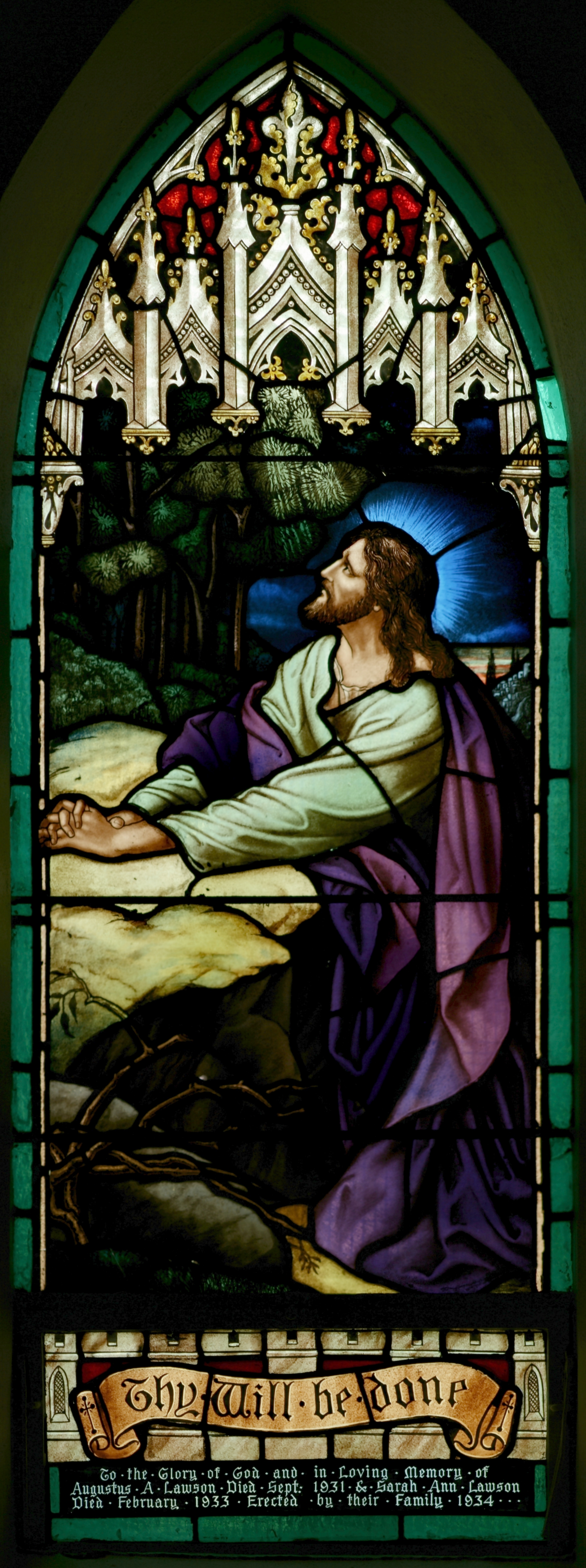
Praying in the Garden

StJohnsAshfield_StainedGlass_GethsemaneThe night Jesus was betrayed and arrested he went with his disciples to a favorite place, a quiet place at night I’m sure called the Garden of Gethsemane.  It was in this place that the final minutes ticked down to his passion.  Matthew records this garden scene in Matthew 26:31-46. Here are five personal reflections.

We are always at risk of stumbling (vv. 31-32).  Jesus warned his disciples they would stumble.  They didn’t believe him.  They were sure they wouldn’t. And then, they stumbled.  Life is a pathway filled with stumbling stones and slippery, unstable ground.  Jesus says we are vulnerable on the journey.  “You will stumble because of me.”  All it takes is a cross word, a threatening action, a worldly temptation, and down we go.  The disciples swore to high heaven they’d never be offended because of Jesus.  Never.  We are at risk.  Seriously.

We are bent toward thinking more highly of ourselves than we ought to think (vv. 33-35).  Catch Peter’s words as he expresses the feelings of the whole group in response to Jesus’ warning that they would stumble: “I will never…I will not…”  Never! But they did.  They did the very thing they said they would never do, and they did it a short while after declaring they never would.  The flesh is confident in itself.  Very confident. However, bold declarations of faithfulness to Jesus that are made in the flesh will retreat in the face of real threats.

We need companionship (vv. 36-38).  The vulnerability of Jesus in this scene is haunting.  Sorrow and deep distress surrounded him.  Trouble was pressing in on him from every direction.  The weight of what he was about to endure is descending upon him.  What did he want? He wanted human companionship. That’s interesting.  Wasn’t the fellowship of his Father enough?  That’s not the point here.  Jesus was a man and as a man he wanted the companionship of his friends in that dark hour.  He didn’t want to be alone.  Of course he could turn to his Father and he did, but what did his Father tell him?  “This is what you came to do, my Son.  The hour has arrived.  It’s time.”  There would be no deliverance from his Father.  Soon, in fact, his Father would forsake him. The sorrow, anguish, and loneliness were all part of the Father’s will for they were all consequences of sin.  Oh how Jesus longed to have these men be with him and watch with him!

We are weak when it comes to spiritual action (vv. 40-46).  “The spirit is willing but the flesh is weak,” Jesus said.  He asked, “Could you not watch with me one hour?”  No, they couldn’t.  When he came the third time and found them sleeping he asked, “Are you still sleeping and resting?”  Yes, they were still sleeping.  That’s not what they wanted to do.  They wanted to remain and watch with him.  They wanted to pray with him.  But their flesh was stronger.  They were tired and they fell asleep.  When temptation comes, and it will come, the risk is that the flesh will win, and we will fail.  Will-power does not produce effective spirituality.

We must learn to depend on prayer (vv. 36, 39, 42, 44).  Jesus did.  He invited his disciples to be with him, to watch with him, and to pray with him.  They did the exact opposite: they slept.  Danger was lurking in the dark shadows of that garden.  Hell was about to launch its assault and God was the target.  The destiny of the human race was hanging in the balance.  Jesus knew this.  He knew what lay ahead.  This was the most critical hour in human history.  And the disciples slept while Jesus watched and prayed. When the hour arrived, Jesus stood true to the Father’s will while the disciples fled. The flesh wants control (it always wants control), but the flesh will fail. Prayer is a means by which we put the flesh to death for only then can the spirit be strong.  Prayer is how we watch so we won’t be overtaken in temptation.  It’s how we abide in the presence of Jesus.

On the night in which he was betrayed by a friend, Jesus prayed.  His disciples didn’t.  And it made all the difference.

Posted in Uncategorized | Tagged , , , | Leave a comment

“How Long ’til We Get There?”

driving home for christmasWhen I was a kid, traveling was part of our Christmas holiday.  My family lived in Maryland and my grandparents lived in New York state.  As soon as Christmas break arrived my parents, four siblings and I would pile into our Chevy station wagon with luggage and gifts tucked in and begin the northward trek.  We would eagerly watch along way, waiting to see the first signs that there would be snow on the ground for Christmas.  I can’t remember exactly how long it took us to make the trip because at that young age anything over an hour was a long time. Part way into the trip that old familiar question began to be asked, “How much longer ’til we get there?” As I grew older I became more aware of some recognizable mile-markers along the way that would clue me in as to how much time remained until we would pull into the driveway of my grandparents’ home and run into their welcoming arms.

David, the shepherd, warrior, poet, musician, and king of Israel, asked the question, “How long?” four times in Psalm 13.  “How long, O LORD?  Will you forget me forever? How long will you hide your face from me? How long must I take counsel in my soul and have sorrow in my heart all the day? How long shall my enemy be exalted over me?” Feeling forgotten, avoided, alone, and defeated, David cries out, “How long?”

That question pulsated like a beating heart in Israel around the time of Jesus’ birth.  The Old Testament prophecies foretold the coming of Israel’s Prince of Peace and Deliverer. While many just went about the affairs of their lives and weren’t tuned into that wavelength, others were.  Messianic expectation hung in the air. “How long?”

“It’s not long now,” declared John the Baptist in a manner hard to ignore. John burst on the scene in a dramatic manner raising these expectations.  “He’s coming,” John said, “so get ready!” Some did.  Most didn’t.  As a result, their Messiah came and went and they didn’t know it. The nation missed God’s visit to earth and his thirty-three year stay in their midst.  And so for Israel the cry continues, “How long?”

David’s plea expresses the feeling that God was not doing anything; that he’d forgotten David, hidden from him, left him all alone to figure out his problem, and not brought the deliverance he desperately wanted.  His “how long” questions put the onus on God to do something for David, because until God did something, it sounds like David couldn’t do anything.

However, David could do something and by the end of the psalm he did.  “I have trusted in Your mercy.”  He remembered that God had always been merciful to him and therefore could always be trusted.  “My heart shall rejoice in Your salvation.”  He remembered that God had saved him over and over again from his enemies and that God was the Savior of his soul, and as he thought about that, his heart rejoiced.  He remembered that God had “dealt bountifully” with him, and in that truth he found reason to sing.  So David went from pleading, “How long, O LORD?” to trusting, rejoicing, and singing as he remembered that God had already been very generous to him.

It’s not wrong to ask “how long?” However, in this psalm, it seems that the question is directed to the wrong person.  David asked the question of God, when, perhaps, he ought to have been asking the question of himself.  Like David, I can find myself asking God, “how long, O God, before you show up, help me out, and come through for me?” when maybe, it would be better to ask myself, “How long ’til I remember what God has already done for me?  How long ’til I remember the mercy and salvation God has already given to me?  How long ’til I remember the generous grace of God already poured out on me?  How long ’til I get there?”

In this Advent season, “how long” is an appropriate question to ask and a great question upon which to meditate, but let that question go both ways — upward and inward.  God is right where he needs to be doing exactly what needs to be done and he is right on schedule. How long ’til we get there?

Posted in Uncategorized | Tagged , , , | Leave a comment

The Resistance to Christmas

1208573_69660271The other night in family devotions we read from John Piper’s Good News of Great Joy: Daily Readings for Advent, published by Desiring God.  The reading focused on the theme of resistance to Jesus and highlighted two demonstrations of resistance in the Christmas story as narrated in Matthew 2.  King Herod embodies the first kind of resistance that demonstrates itself in violent opposition to Jesus.  Herod sought to kill the Christ Child and put an end to any potential rival.  The chief priests and scribes embody the other kind of resistance in their amazing indifference to the birth announcement delivered by the magi from the East.  Though the scribes were biblical experts and able to quickly identify the prophesied birthplace of the Messiah, and though the priests were in charge of the religious life of Israel, all of which anticipated their coming Redeemer, neither of these groups showed any interest in the reported birth in Bethlehem, and neither investigated the report any further.

As we sat around our dinner table, we talked about these two forms of resistance, observing that in our particular situation, the resistance we most often face is that of indifference to Jesus Christ.  While not facing life-threatening opposition to Jesus, we do find ourselves surrounded by a general sense of carelessness regarding him.  Jesus just doesn’t matter to many people.  It’s not that they don’t think he existed or is important, it’s just that he’s not much different from the multitude of heroic figures from television and movies that fill the minds of a media-saturated culture.  Though Jesus is a major player in the religious world, he is little more than a mental icon tucked away in the religious compartment of peoples’ personal lives only to be brought out when convenient. Indifference is a tough barrier to break through: people who know about Jesus, even true things about Jesus, claim to admire him, but beyond that are indifferent to him.  I wonder if one reason churches across our land are having such an insignificant spiritual impact is because of the number of priests and scribes sitting in the pews. Indifference to Jesus is a subtle form of resistance, but resistance just the same.

As we continued to talk after dinner about the resistance present in the Christmas story, we remembered the fact that though we are not confronted with it, the resistance of outright opposition to Jesus exists in many places in our world.  In that sense King Herod is alive and well embodied in those who will to go to any lengths to prevent the name of Jesus Christ from being spoken and to stop the spread of the his gospel.  CAR Trip 299 (2)I showed my family this picture of a follower of Jesus Christ named Doui.  He was a pastor in the Central African Republic who recently was killed by those who oppose Christianity and would like to rid their region of Christians.  I met Doui five years ago when I was in that country and had the opportunity to preach and teach God’s Word to Central African pastors for two weeks.  Doui was among that number of brothers in Christ who sat in the classroom for hours diligently taking notes.  Since he was one of the better English speakers in the class, he helped with some of the translating for other students, and he and I were able to personally interact more easily because there was no language barrier.  Doui worked hard to support his family in addition to shepherding a church.  Opposition to Christ ended his earthly life, but ushered him into the presence of his Savior.  I include his picture as a tribute to his faithfulness to the Lord and to the care of his congregation, as well as to serve as a reminder that violent opposition to Christ still exists.

King Herod, the chief priests, and the scribes are still around this Christmas.  There is still an active and open Christmas resistance.  Don’t get hung up on the resistance to December 25th traditions and slogans.  See it for what it really is: “Light came into the world, but men loved darkness rather than light because their deeds were evil” (John 3:19).  Jesus said, “I am the light of the world. Whoever follows me will not walk in darkness, but will have the light of life” (John 8:12).  The encouraging thing to remember in the face of resistance is that light overcomes darkness.  The Child in the manger was stronger than the king on the throne and wiser than the religious authorities of his day.  He will win!

Posted in Uncategorized | Tagged , , , , , | Leave a comment

What’s Your Number, Pastor?

numbersThere it was in an email I had received.  I predicted out loud to my wife on our way home from church that another one was slipping away.  My mind raced to figure out what I could do to tighten my grip so I could hang on a little longer though I was fairly certain there was nothing I could do. I’d been there before, and every time it was disappointing.  But I’m ahead of myself.

I like the movie The Guardian. It is the story of two Coast Guard rescue swimmers Jake Fischer and Chief Ben Randall. Jake arrives at the Coast Guard Academy a cocky, yet determined, recruit who is driven by an inner need for absolution. Randall is ready to retire from the Guard but answers one last assignment to train this incoming class of recruits. Trying to prove himself, Fischer is determined to break all the swimming records at the academy, especially when he learns that the records belong to Randall. He succeeds, but there is one record that especially interests him: his chief’s number, that is, the number of people Randall had rescued. Unlike the other swimming records, that number wasn’t posted anywhere. Later in the movie after Fischer and Randall have worked through some important issues and are serving together on rescue operations, Fischer puts the question to his chief.

Fischer:  “What your real number?”
Randall:  “22.”
Fischer:  “22?  That’s not bad.  It’s not 200 but …”
Randall:  “22 is the number of people I lost, Jake.  The only number I kept track of.”

That dialogue haunts me and here’s why. When asked what “their number” is, pastors like me tend to gravitate to the number of members in the church, the number of attenders at worship services and special events, the number of people who walked the aisle, or even the number on the bottom line of the budget. In other words “our number” is a success number; a number that somehow validates us as leaders. I get it because I’m prone to do it.

When Jesus talks about a pastor and church He uses the language of shepherding a flock of sheep. That is what the term “pastor” means, shepherd. A local church is a flock of sheep under a shepherd’s care, the assignment to which is made by the Chief Shepherd, Jesus Christ.

As I read the New Testament I come to the unmistakable impression that it is really important to watch over the flock so as not to lose one. Losing sheep is undesirable, whether the loss is due to a wolf, a thief, or a sheep’s own wandering away.  If the shepherd owned the flock, he was protecting his own property and livelihood.  If he didn’t own the flock, he was accountable to the real owner to care for the owner’s flock and responsible to not lose any of the owner’s sheep.  So important was it to not lose any sheep that Jesus told a parable about a shepherd who left ninety-nine safe, healthy, protected sheep to go look for one lost sheep.  He told that parable because that’s the kind of shepherd Jesus is.

As I read the Old Testament I come to the same conclusion regarding a shepherd’s care of the flock.  When Ezekiel chastened the leaders of his day, one of his indictments was that the shepherds had not gone after the stray sheep (Ezekiel 34).  In the Old Testament context, the sheep were the people of Israel and the shepherds were Israel’s leaders.  The parallels to pastoral responsibility are clear and the language too similar to ignore.  Listen to the indictments:

  • “The weak you have not strengthened, the sick you have not healed, the injured you have not bound up, the strayed you have not brought back, the lost you have not sought.” (v. 4)
  • “My sheep have become a prey, and my sheep have become food for all the wild beasts, since there was no shepherd, and because my shepherds have not searched for my sheep, but the shepherds have fed themselves, and have not fed my sheep.” (v. 8)
  • “For thus says the Lord God: ‘Behold, I, I myself will search for my sheep and will seek them out.’” (v. 11)

It’s easy to lose sheep.  Wandering comes naturally to them.  There are greener pastures, calmer streams, more shade, and better defenses elsewhere.  And yes, the temptations of the world that capture the imaginations of sheep never stop drawing some away.  Depending on the size of the flock it’s easy to overlook the stray.  The incessant demands of ministry responsibilities make it hard to find time to go out on search and rescue missions.  The endless difficulties in people’s lives can leave a pastor wondering if it’s worth the time and can change a careless shepherd into a less caring one.  Yet, to be like our Shepherd Jesus means caring enough to go searching.  Remember what happened when Adam and Eve strayed?  It was God who called out, “Where are you?  Why are you hiding? What’s happened?”

Some think you ought not to obsess about such things as lost members because it can be too discouraging and thus counter-productive to pastoral ministry.  To keep that number in your mind seems to sacrifice too much attention to failure which can be defeating for a pastor.  I respond by saying that I don’t obsess over lost sheep but I do remember. I don’t remember them all by name, so I don’t have a fixed number in my head, but I do know there is a number, and for certain, the Chief Shepherd knows what it is. Thank God for a gracious Chief.

I know I won’t be 100% successful in finding and recovering all the strays. Not all the sheep of our earthly flocks belong to God’s flock which means the pursuit of straying sheep who think they’re in God’s flock but aren’t will usually be in vain. Not truly belonging to Christ, they don’t hear His voice and thus they don’t follow Him (John 10:27), and if they don’t hear the Chief Shepherd’s voice they won’t hear the under-shepherd’s voice either. Not only that, the shepherds of the flocks are not perfect like the Great Shepherd and they disappoint their sheep.  Sometimes disappointed sheep look for greener pastures, healthier flocks, and better shepherds, and they won’t have to look far to find what they’re looking for.  In spite of all of this, it is good to know that we have a Shepherd who will not lose one of His own sheep (John 18:9)!

I rejoice in every sheep the Lord brings into the flock under my care and I want to give them my undivided attention.  But there is a part of me that remains regretfully aware of the ones I’ve lost. I don’ t think there is anything to be gained by keeping a number, but lest any of us pastors become too enamored with “our numbers,” it’s not a number to ignore, because every soul matters to God.

Posted in Uncategorized | Tagged , , , , , , , , , | 1 Comment

The Knowledge of Good and Evil

forbidden_fruit_small_500px“What God says doesn’t matter! What God declares to be off-limits isn’t really off-limits if you don’t want it to be off-limits.  You have just as much right to decide good and evil for yourself as God does.  If you want to listen to him, that’s totally up to you, but you don’t have to.  You can decide for yourself.” That’s what the serpent told Eve in Genesis 3:4-5. And she believed him.  And so she took that piece of delicious-looking, freedom-offering, God-forbidden fruit and sunk her perfect teeth into it.  “Hey Adam, you gotta try this!”  And he did.

The immediate result of their decision was anything but the liberating self-awakening they had been promised. Instead a tidal wave of negative self-consciousness, fear, and shame swept over them.  The nakedness the man and woman had experienced without shame in Genesis 2:25 gave way to nakedness accompanied by shame in Genesis 3:10.  This new feeling was not caused by God but by the actions of Adam and Eve.  They were already stitching together the fig leaves and hiding out in the bushes before God ever came looking for them.  When they chose a good and an evil that were contrary to what God had said, they were immediately filled with shame and it was their shame that created the fear and it was their fear that caused them to hide.  All of that happened before God ever called out to Adam, “Where are you?”  If it’s true that they had the right to choose good and evil for themselves regardless of what God said, then why were they ashamed, fearful, and hiding from God instead of cavorting in their new-found freedom?  “Hey God, look at us!”

God is a startling reality check!

It didn’t take long for the initial shame of sin to subside and for humanity’s discovered freedom of choice to accelerate at full-throttle.  In Genesis 4 an older brother murders his younger brother, and a man marries two wives.  In Genesis 6:3 God accuses humanity of striving against Him at every turn.  No shame.  No restraint.  Just self-indulgence; man choosing good and evil for himself regardless of any threatened consequences (Gen. 6:5).

Fast-forward a couple thousand years to the apostle Paul’s written explanation of the lost condition of humanity in Romans 1:18-32.  What he describes is the result of the choice Adam and Eve made back in Genesis 3.  The results of their freedom of choice are listed by Paul, not comprehensively, but quite specifically.  Some of those results include: a denial of reality, glorifying everything but God, futile thinking, darkened understanding, believing lies, and lifestyles contrary to naturenature being defined as that which God created and ordered. By the time you arrive at the end of Paul’s litany of indictments, the shame evidenced by the first sinners in Genesis 3 is nowhere to be seen in Romans 1, for the ones guilty of living by their own God-defying rules aren’t hiding in shame but are actively encouraging others to do the same (Rom. 1:32).  It’s as if they’ve come out of hiding, torn off the fig leaves and are cavorting shamelessly, defying God to do anything about it.

The choices men and women make regarding good and evil do not nullify the enduring laws of God that define what is good and evil.  Man cannot write laws that overturn God’s laws. Man can either write laws that correspond to and cooperate with God’s moral laws or man can write laws the compete with or contest God’s laws.  Man cannot nullify God’s laws.

A philosopher has observed that if a real tree is in the middle of a real road and you are driving a real car and run into the real tree, you will feel its real impact even if you denied all along that the tree was ever there. Denying the existence of something that is real does not make it unreal.  Our nation continues to ignore God’s laws.  Our culture is pushing the gas pedal to the floor acting as if the tree we’re heading straight toward at 90 mph isn’t really there.  But it is.

The Congress can pass any law it pleases; the President can sign any bill he chooses; the Supreme Court can render any judgment it wants; the electorate can support any of these they decide to support.  All of the preceding can treat God and His laws as imaginary.  But if man’s laws ignore God’s, there will be a collision, and when the smoke from the fiery crash dissipates, you will find man’s laws a total wreck and God’s laws unmoved.

God is a startling and a sobering reality.

I’m sure glad He’s gracious and merciful toward lawbreakers like me!

Posted in Politics, Uncategorized | Tagged , , , , , , | 2 Comments