Let There Be Peace

Peace_PineNeedlesThis is a season of hoping for peace on earth and goodwill among men. And why should we not hope? The angels announced it to be so at the birth of Jesus.  Yet, where do we find ourselves two thousand years later?  In our nation, the anxiety levels are on the rise as one killing event after another is thrust into the 24-hour news cycle leaving one to wonder, “Will it ever stop?”  2015 will not go down in the annals of history as a year of peace.

The New York Times ran a story today, “Fear in the Air, Americans Look over Their Shoulder,” which explores the increasing anxiety, fueled by tragedies like the most recent attacks in California and Paris.  No place seems safe anymore — going to school, eating in a restaurant, watching a movie at the theater, attending a concert, shopping in the mall, going to a Bible study at church, and going to work are all killing grounds. The author of the article wonders, if there’s no safety in those places, is safety even a realistic expectation any more?  A 62-year old grandmother in Austin, Texas was exasperated that her country can’t solve this problem. A 23-year old Cleveland girl said it all makes her “hate this world.” The tangled emotions leave some desensitized, while others are bewildered, angry, and asking, “Why must I feel so helpless? What kind of world must my children live in? Why won’t it stop already?”

Talk of peace lends itself to pious platitudes so often disconnected from reality.  But I’d like to venture a theological explanation for the absence of peace on our streets, in our homes, and in other ordinary venues of life.

The fact is humans simply cannot build the kind of world they want to build. The human race wants a world of peace, pleasure, and prosperity, but their starting point is all wrong because it is Self:  “I want peace, pleasure, and prosperity first and if I get it then I’ll think about getting it for you, too.  But if I don’t get it neither should you.”  The world wants what it wants, but it wants it without God. Without God as the cohesive center, every individual and every group are left to themselves to figure out how to achieve this dream.  Without God, it leaves Self or a collection of Selves at the center. As long as that is true, this world will not experience the peace, pleasure, and prosperity it so desperately longs for. Seven billion people will never unite on their own for the universal good of mankind to the glory of God.

As all pretense of honoring God evaporates from our culture under the constant heat of godlessness, peace vanishes with it. Thousands of years ago, the prophet Jeremiah spoke to his nation which had known the gracious hand of God, but had turned away from Him.  They were experiencing the consequences of their decision and longing for peace.  Our nation needs to take to heart his timely words.

To whom can I speak and give warning?
Who will listen to me?
Their ears are closed
so they cannot hear.
The word of the Lord is offensive to them;
they find no pleasure in it.
But I am full of the wrath of the Lord,
and I cannot hold it in.

“Pour it out on the children in the street
and on the young men gathered together;
both husband and wife will be caught in it,
and the old, those weighed down with years.
Their houses will be turned over to others,
together with their fields and their wives,
when I stretch out my hand
against those who live in the land,”
declares the Lord.
“From the least to the greatest,
all are greedy for gain;
prophets and priests alike,
all practice deceit.
They dress the wound of my people
as though it were not serious.
‘Peace, peace,’ they say,
when there is no peace.
Are they ashamed of their detestable conduct?
No, they have no shame at all;
they do not even know how to blush.
So they will fall among the fallen;
they will be brought down when I punish them,”
says the Lord. (Jeremiah 6:10-15)

Where there is no godly shame, there can be no peace.  Where the Word of God is resisted, there can be no peace.  Where preachers give false hope through feel-good sermons, there will be no peace.  I guess that’s as good a theological answer I can give to the mournful question, “why won’t it stop?”  As long as we (Self) are the center there will be no peace.  

The hope for peace inspired by this season does not rest in any of us, but in the birth of a child whose name shall be called “The Prince of Peace.”  O that our world would receive Him!

Posted in Uncategorized | Leave a comment

Checklist for a Great Worship Service

00a223c1-704c-43c1-8810-b297cd35c881My wife does most of the legwork of planning the Sunday morning worship service orders for our church.  She and I talk through the theme and then she sets to the task of choosing songs and putting them in an order along with the other components of the worship service.  When that task is completed, there is the need to communicate the details to each of the team members that lead on the platform, the sound and video crew, and the ushers.  On any given Sunday the communication loop involves fifteen to twenty people.  At the end of the service, one might measure success in terms of a smooth flow, everyone being where they needed to be when they needed to be there, no technical problems or missed cues in the audio or video, and each component of the service ending relatively close to the targeted times.

Have you ever thought of your checklist for a great worship service?  This past Sunday I proposed two to the congregation, and I offer them up to you.

Checklist #1

  • I sat in “my pew” and it wasn’t too hard or too soft.
  • The temperature was just perfect, not too hot or too cold.
  • No one’s cell phone went  off around me during the service.
  • We sang my favorite songs.
  • The sermon was “deep” and long; or the sermon was short, sweet, and to the point (your preference).
  • We got out on time.

Checklist #2:

  • I prepared my heart to worship before the service started.
  • I sang with my mind engaged, my heart enthralled, and my voice united with those around me.
  • I prayed.
  • I listened attentively to God’s Word.
  • I responded in humble obedience to God’s Word.

The point of a corporate worship service is to encounter God.  The music, prayer, Scripture reading, sermon, and response are all aimed at that one thing.  Which list do you think is most likely to get you there?

Posted in Uncategorized | Tagged , | Leave a comment

What’s Good about Good Friday?

Jesus-on-the-crossHave you ever wondered what is good about Good Friday? How can the things that happened on that day and the horrors of Christ’s suffering be good?  How can it be good that he was falsely accused and wrongly condemned and unjustly crucified?  What is good about that?  It seems “Horrible Friday” would be a better designation.

Go back to the beginning, when God created the heavens and the earth. He did so with power and perfection, and the creation account repeats, “God saw that it was good.”  When his creation was finished God saw everything he had made said it was very good.

Then something horrible happened.  The man and woman God created rebelled against him in an act of treachery perpetrated by the deceptive schemes of Satan. The creation God made was marred and scarred with the result that the man and woman were barred from fellowship with God. But God did not abandon his creation; he did not give up and walk away from the man and woman he created.  No.  He promised to fix the problem, even though the fix would be costly and painful.

When God created the heavens and the earth he just spoke it all into existence.  But fixing what was broken would not be that easy.  To do so, God became a man in the person of Jesus Christ, born of the virgin Mary.  He was a perfect sinless man who was God.  It was this God-Man who willingly went to the cross, who became sin for sinners, who suffered in the place of sinners, who paid the debt in full.  He did not deserve it, so from a human perspective his suffering was unjust.  But we did deserve it.  So Jesus took on himself what we deserved so we could go free.  From the cross with the last breaths he had within him, Jesus cried out, “It is finished!” Just like God finished his original work of creation and declared it to be good, so now Jesus finished the work of redemption. “It is finished” meant the work was done and the work was good, in fact, it was very good.  Forgiveness for sin, salvation from hell, and reconciliation to God were now available to any and all humble enough to receive these gracious gifts.

That is what is good about Good Friday.

Posted in Uncategorized | Tagged , , , , | Leave a comment

The Leader, the Witch and the Warning

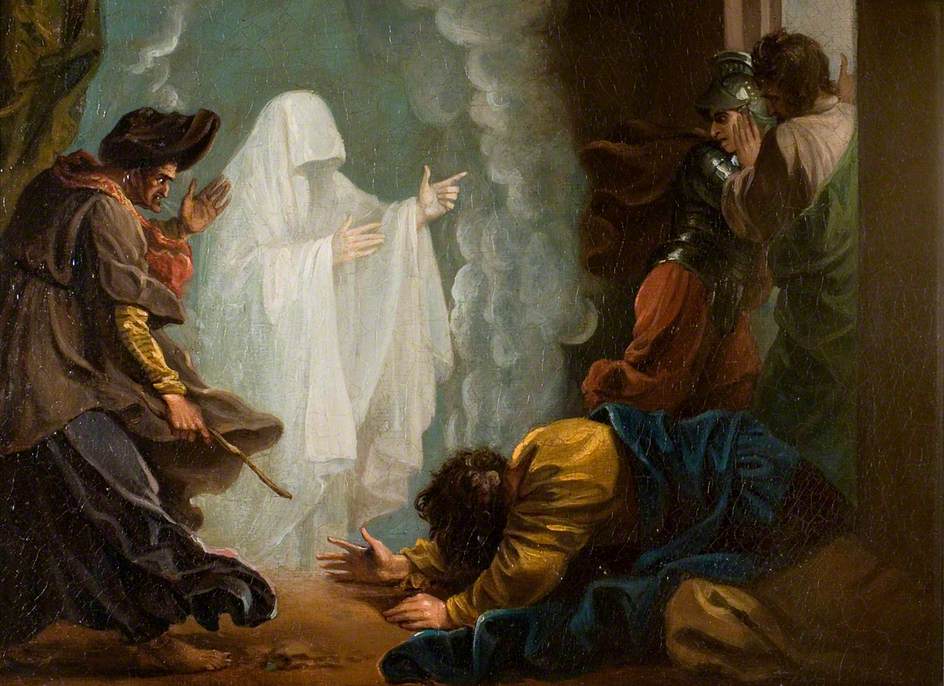
(c) Paintings Collection; Supplied by The Public Catalogue FoundationThe encounter of King Saul with the witch of En Dor in 1 Samuel 28 is one of the most bizarre incidents in Saul’s life, and even more so, in all the Bible. Who was this woman? What kind of powers did she possess? Did this woman actually call Samuel up from the dead as Saul asked her to do, or did Samuel show up because God sent him, and if God sent him, why? Can the dead come back as spirits to communicate with the living? Are the spirits of humans wandering the earth? Are seances for real?

Those questions are intriguing. The problem is the story does not answer those questions because the questions raised are not the purpose for this incident being included in the narrative of Saul’s life. This incident is not intended to be a lesson about life after death. You could spend all your time in this passage trying to answer those questions with in-depth studies that would lead to no absolute conclusions, maybe drawing conclusions that would misdirect you, and in the process cause you to miss the point.

The overarching meta-narrative of the Saul and David stories is about a leader’s heart and God. David was a man after God’s own heart (explicitly stated in 1 Samuel 13:14 and Acts 13:22).  In contrast, Saul was not a man after God’s heart (repeatedly illustrated throughout his life and set in deliberate contrast to David). Saul trembled greatly In 1 Samuel 28:5 because the Philistine army (his nemesis) came up against him. When he asked the Lord what he should do, the Lord did not answer him. No dream or vision, no answer through the Urim and Thumim (a means of inquiry God gave to the Old Testament priests), no prophetic word. The prophet Samuel was dead. When no answer came, Saul’s solution to the dilemma of discerning the future was to find a witch, someone who engaged in the practice of communicating with the dead. This practice was strictly forbidden by God’s law (Leviticus 19:31) and Saul had cleansed the land earlier of those who practiced it (1 Samuel 28:3).  Now he’s a customer.  These kinds of actions have been the habit of Saul’s leadership. In a prior encounter with the Philistines, Saul made a sacrifice he was not authorized to offer (1 Samuel 13:5-14). On another occasion the Lord commanded Saul to completely destroy the Amalekites, but Saul modified the plan (1 Samuel 15). Saul’s habit as a leader was to obey the Lord as long as it worked out the way he thought it should, and when it did not, he would choose another course.

What is interesting about Saul is that he knew how to mix his religion into his leadership. He consulted with the prophet of the Lord, he made sacrifices to the Lord, and on another occasion when he went up against the Philistines he compelled his troops to fast for a victory over their enemies (1 Samuel 14:24). He knew the techniques of leading under God, but his heart was empty.

So near the end of his life, Saul is found in En Dor consulting with a woman who leads seances and consults with spirits. Apparently he’d been fasting again (1 Sam. 28:20).

Saul comes across as a leader who acted as if methods could get him what he wanted, but he learned that there is no magic in methods when it comes to leading under God. Success with God lies in the heart.  Even godly methods don’t work if the leader’s heart is not right.  The heart that is right is the heart that trusts. The heart that trusts is the heart that obeys. The heart that obeys yields actions that evidence true faith. Those actions may include sacrifices or fasts, but Saul jumped to the latter while ignoring the former.

Leaders risk the same in this age that emphasizes perfecting technique in ministry: offering the glorious sacrifices of programming devoid of true heart surrender; cloaking themselves with spiritual practices without true heart surrender that yields a pseudo-spiritual leadership. There is no magic in methods because the power belongs to God. Sometimes he communicates and works in bizarre ways because he can. The point is not that we adopt that method, otherwise we should be having seances along with our prayer meetings in order to divine the future. In the end what God wants is the heart. He doesn’t want a leader’s creativity, hard work, skills, or well rationalized strategies. He wants the leader’s heart because if God gets the leader’s heart, he will have the leader’s creativity, hard work, skills, and rational abilities, but all of them surrendered to God.

Saul never got that. David did. And so must every leader.

Posted in Uncategorized | Tagged , , | Leave a comment

Adapt or Die

120916burnchurch-340x170A little over a week ago, jihadists executed 21 Christian Egyptian men.  None of the martyrs were wealthy or educated.  They had gone to Libya looking for work and ended up in the hands of ISIS.  In a picture accompanying the article I read, the men were kneeling on a beach with a gray overcast sky in the background.  Each was dressed in an orange jumpsuit and behind each man stood a black-clad, hooded terrorist, knife in hand, ready to do his bloody deed.  These men were targeted because they were “people of the cross.”  According to this report, they were tortured in an effort to persuade them to deny Jesus and save their lives.  Another report said they were whispering the name Jesus as they were executed.  Presented with the choice of denying Christ or dying, they chose death.

Just days later another story hit the news circuit, this one situated in America.  This one involving an author and former pastor heralded as one of the most influential Christians in America. His name is Rob Bell. Clad in hipster skinny jeans, sitting on rattan furniture in a cozy outdoor setting, Bell  was being interviewed by the guru of secular spirituality, Oprah, and they were discussing his endorsement of same-sex marriage (you can read about it here). In that interview, Bell stated he is convinced the Church is just “moments away” from accepting same-sex marriage.  Asserting that churches which don’t embrace same sex-marriage are a dying subculture, Bell makes this audacious claim: “You sort of die or you adapt.”

In a word, there is his theology — adapt.  If you’re at all acquainted with Rob Bell you will come away from his books and talks with the distinct impression that Bell’s brand of Christianity isn’t really derived from an honest representation of what the New Testament teaches. In reality, he is more committed to cultural relevance than to actual truth.  I think he would take that observation as a compliment. In his opinion, the Bible is outdated when it comes to establishing timeless norms for things like marriage, and it is horribly misrepresented in traditional Christian belief on the subject of hell.  Rob Bell left the church he founded and pastored due, in part, to a fallout with the congregation over the less than orthodox views he expressed in his book Love Wins, stating he left to “search for a more forgiving faith.”

My purpose in this post isn’t to get into the same-sex marriage issue.  My focus is on this “adapt or die” brand of Christianity promoted by such an influential person.  His adaptable doctrine speaks volumes about the American brand of Christianity that is so popular these days.  Christian martyrs down through the centuries wouldn’t buy Bell’s mantra.  And neither should we.  Those 21 Christians kneeling on that desolate beach demonstrated that Jesus – and what He says – is worth dying for.

Sometimes it is better to die than adapt.

Posted in Uncategorized | Leave a comment