It May Sting but It Doesn’t Have to Stick

I read the lines a few times to make sure I understood what I was being accused of. Even though I didn’t believe it was true, the accusation still stung. Words can do that whether or not they are true, and sometimes they can hang on you like heavy snow on the branches of a pine tree.

Satan is the master of accusation. He never misses an opportunity to bring full-blown charges, subtle insinuations, or outright slanderous accusations against Jesus’ followers. It’s easy to succumb to Satan’s accusations because, all too often, the sins he points out are true: “Yes, I did that; yes, I said that.” I’m learning I don’t have to run and hide or sink into despair in the face of the accusations because, truth is, even though they are true, the accusations don’t stick.

The reason the accusations don’t stick is tied to the New Testament concepts of being blameless and above reproach. Neither of these virtues refers to a sinless person because being above reproach or blameless is not the same as being perfect, in the way we commonly use that term. The Apostle Paul never claimed such perfection in his earthly life as seen in his personal testimony in Phil. 2:12-14:

“Not that I have already obtained this or am already perfect, but I press on to make it my own, because Christ Jesus has made me his own. Brothers, I do not consider that I have made it my own. But one thing I do: forgetting what lies behind and straining forward to what lies ahead, I press on toward the goal for the prize of the upward call of God in Christ Jesus.”

Paul did not attain sinless perfection. It wasn’t his pursuit. Obedience to God’s call was. This blameless, above reproach living I’m describing is not a life that is free of errors, in which a sin is never again committed. The pursuit of that kind of perfection will lead either to pride or utter defeat. As songwriter Andrew Peterson wrote, “You can’t expect to be perfect, it’s a fight you’ve gotta forfeit.”

Yet, because a sinless life is not possible, Satan will continue to point out my sins, leaving me vulnerable to his ongoing accusations. What then is my hope?

Imagine a courtroom scene. I am the defendant on trial. The prosecutor is Satan, the accuser of Christians (Rev. 12:10). The defense attorney is Jesus Christ (1 John 2:2). The presiding Judge is God. I have sinned. Satan levels the devastating charges, accusing me of violating God’s law, thus worthy of condemnation and its accompanying punishment. But when Satan is finished, Jesus rises to my defense, both acknowledging the truth of the accusation, and declaring that the penalty for the sin has already been paid in full through His own sacrifice on the cross. Justice has been served. The defendant is not guilty. There is no double jeopardy in this courtroom. Case dismissed! 

“There is therefore now no condemnation to those who are in Christ Jesus…Who shall bring any charge against God’s elect?  It is God who justifies.  Who is to condemn?  Christ Jesus is the one who died–more than that, who was raised, who is at the right hand of God, who indeed is interceding for us” (Rom. 8:1,33,34).

Satan’s accusations are dirty but they’re not deadly. They sting because they are too often true, but they don’t stick because Jesus is rewriting my story.

Posted in Discipleship, Uncategorized | Tagged , , | 1 Comment

Caught in the Storm

Darkness was setting in as Jesus’ disciples launched their boat onto the open waters of the Sea of Galilee. After miraculously feeding a crowd of more than 5,000 people, Jesus had instructed the disciples to cross the sea and return to their home base in the village of Capernaum. The dark of night was not the ideal time to be navigating a boat across open waters. But these fishermen were not intimidated by this, as they had often worked through the night on these very waters. On this occasion, however, Jesus did not accompany them.

Storm clouds gathered as the disciples attempted to sail to their destination. Storms on the Sea of Galilee were nothing new and the fishermen were not surprised. But the strong winds and fierce waves prevented the disciples from making progress toward Capernaum. As the storm engulfed them, they realized they were stranded at sea with no escape in sight.

In the midst of the darkness, Jesus appeared. He came to the disciples, striding over the fierce waves, unfazed by the force of the wind. Sailing in a storm and rowing against the waves were familiar to them. A man walking on the water was not. And they became terrified. Recognizing their fear, Jesus spoke to his disciples with words of assurance, “It is I, do not be afraid!” Recognizing the voice of their Master, they invited him into their boat. And at the very moment as Jesus stepped into their midst, they found themselves at their destination. This man, their Master, had rescued them.

Life is filled with storms. The winds and waves of adversity create havoc for us, and we feel little progress being made. We find ourselves stuck in the storm. But, like the disciples, the storms can feel familiar to us. We know how these things go in life. We aren’t looking for a rescuer. We are just going to ride it out. But then Jesus enters into the situation in an unexpected way, much like his walking on the water. He appears where we don’t expect him. He takes us into unfamiliar territory. And he asks us to trust Him.

Obedience, the essence of trusting, is like that. In the difficult and uncomfortable circumstances of life, obedience compels us to do difficult and sometimes uncomfortable things. In our minds, the path of obedience becomes more frightening than the storm itself. So we choose to remain stuck in the storm. But Jesus offers us these words of comfort in the midst of the storm, “It is I, be not afraid.” And He offers to get into our boat. When we accept his offer by faith, the fierceness of the storm subsides, and he brings us to the exact place where we are supposed to be.

If you find yourself in the midst of a storm, you can lay down your oars with confidence that whatever Jesus asks you to do is exactly what you need to do to arrive safely home.

Posted in Uncategorized | Tagged , , , , | 1 Comment

Living by Faith in Uncertain Times

We are living in the midst of a host of uncertainties created by the COVID-19 pandemic.  People are isolating and hoarding.  Schools and establishments are being closed and events cancelled.  How serious is this?  Well, they’ve cancelled school, college, and professional sports, which in the words of Mr. Holland, marks the “end of western civilization as we know it” (from the 1995 movie Mr. Holland’s Opus).  Some are of the opinion that all of this is a massive over-reaction, while others are of the opinion that we haven’t begun to see how bad this is going to be.  Both sides seem certain of their predictions.

What does living by faith look like in times like these?  Faith is “the assurance of things hoped for, the conviction of things not seen” (Heb. 11:1).  Faith operates in the realm of the unseen and the “not yet”, and it acts with both assurance and conviction.  To live by faith is to trust God.  It’s not a blind leap in the dark because it is based upon what God has said.  On the one hand, faith is not reckless; it acts with proper caution that’s based on what God has said, not with presumption based on things He has not promised.  On the other hand, faith is reckless.  It is careless of consequences—if obeying God means risk and vulnerability, living by faith will do it.

Faith and certainty go together.  But is there any room for trusting God while at the same time accepting that we will deal with uncertainties?  The uncertainty I’m referring to is not about God; it’s about us and our world.  God knows everything; we don’t.  God has revealed ultimate events that we can know with certainty, but He has not revealed tomorrow’s events, which leaves us dealing with uncertainty.  We “do not know what tomorrow will bring” (Ja. 4:14).

The CDC says that even if every single American was tested for the coronavirus it would still not be known who has it, and therefore, “an accurate death rate is literally unknowable.”  How many have already died?  No one really knows.  A recent news article raised what it called “three unanswerable questions” about this virus: (1) How long will it last? (2) Will the efforts being made to slow its spread work? (3) What will be the new reality?

The mandates and recommendations that have been made are aimed at preventing the spread of this virus.  Prevention is based on if and might, neither of which are words of certainty: if we do this then here’s what might happen.  The ifs and the mights are what knowledgeable people project based on science, mathematics, and history.  Predictions are not prophecies.  They do not declare what will happen, but what could happen apart from some intervention.  An intervention is an “if we do this,” that is aimed at “we might get this result.” And thus, the orders and recommendations.  When the crisis is over, there can be an evaluation as to whether the interventions worked, but even then, there is no certainty as to what would have happened if those measures hadn’t been taken.  Even for those of us who believe in God’s sovereignty and providence, who do not doubt what He can do, there is still the uncertainty created by not knowing what He will do.

So, in the meantime, we will accept the uncertainties that surround this pandemic.  We will not act as if we know how everything will turn out.  We will not presume upon God’s protection as if we were invincible because our trust is in Him.  What we will do is try to make the best decisions we can, not just for our personal well-being, but even more for the sake of one another.  By faith we will stay on mission and we will adjust our tactics, trusting God every step of the way.  We may not know until eternity what those decisions accomplished.

Living by faith does not mean living without uncertainty.  It means accepting uncertainty, trusting God in it, and seeking to make the best decisions you can for the greater good of all.  Only time may tell whether we are over-reacting or under-reacting in this crisis.  But this we are certain of: God can be trusted to keep and guide us through all the uncertainties of today.

Posted in Uncategorized | 2 Comments

“We Will Not Quit!”

The parable of Jesus in Luke 18:1-8 has been titled “The Unjust Judge” and “The Persistent Widow. Which is it? Is the parable about an unjust judge or is it about a persistent widow? It’s about both and if we put them together we catch the theme of this story: persistence in the face of injustice.

It is not unusual to give primary attention to the first five verses, but without verses 6-8, we will miss Jesus’ point. In those verses Jesus talks about avenging His elect and the coming of the Son of Man, both of which must factor into our understanding of what Jesus was teaching in this parable.

Luke gives a summation of the parable as he begins: we must continually pray and not give up praying. But this continual praying is focused on something bigger than simply an unanswered prayer in our individual personal lives. In verses 6-8, Jesus has a time period in view, namely the intervening time between his earthly ministry and his second coming (“when the Son of Man comes”). While waiting for His return, do not give up on prayer. It is the antidote for not losing heart; it is what keeps faith strong.

That Jesus talks about God avenging His own elect who cry out to Him day and night is a reminder of what this intervening time will be like for God’s elect. Circumstances will be such that the elect will cry out for deliverance and for vengeance (Revelation 6:10). Deliverance may or may not come, but God’s promise is that vengeance will come with the return of Christ. This end must be kept in view throughout this period of redemptive history. No matter how dark things become, no matter how pessimistic the outlook, no matter how difficult it gets, no matter how much Christianity seems to make no advance but is in retreat, no matter how corrupt politicians become, no matter how irreverent, divided and violent society becomes, no matter how faithless preachers become, no matter how far they stray from the gospel, no matter how many professing Christians walk away from the truth, no matter how many churches cave in to cultural pressures, no matter how many times our prayers for unsaved neighbors go answered, we cannot give up on prayer. Why? To give up on prayer is to lose faith, and to lose faith is to give up the hope of the coming of Christ.

During this intervening time, God’s elect will often be treated the way the widow is initially treated in the parable. She was seeking justice from an adversary. Given the characters and the setting, it is likely what she was seeking was something she was owed; perhaps a service or commodity had been provided but she had not received payment. As a widow, she was vulnerable—easily ignored and taken advantage of, with no social status, and no husband to stand up for her. The judge is a jerk who did not fear God or care for people. Who knows, it may have been one of the judge’s cronies who owed the widow because he ignored her plea.

In this period of time court decisions, legislation, executive orders, company policies, and school rules may be discriminatory and unjust against Christians. They certainly are in many places in the world and such actions are popping up increasingly in our society. We rightfully plead our case, we ask for justice, but it often falls on deaf ears. Even as I write, a prayer request is on my mind shared in our prayer group regarding a missionary who is in prison in another country on false charges and awaiting trial. If condemned, he may be looking at being in a foreign prison the rest of his life. “How long, Lord?”

The judge in Jesus’ parable finally relented because he realized he was risking his reputation and gave the widow justice. This sometimes happens for Christians, too; sometimes they win.  For example, after being unjustly treated by the governing authorities in Philippi, Paul charged them with violating his rights and insisted on them making amends, which they did (Acts 16:35-40).  But even it doesn’t work out that way, the point to observe is that this widow got her day in court because she continually asked for justice. She persisted until the judge gave in.

Jesus’ point: be like the widow with regard to prayer. This widow had to deal with an unjust and uncaring judge, but she still got her request because she wouldn’t back down. The elect have a Judge to whom they can appeal – God, who is watching over them and who deeply cares for them. If this woman got action from an unjust judge who cared nothing for her, do not for a moment think the elect will get no action from just God. He will certainly vindicate them in the end, and he will do it suddenly. The crucial question Jesus raises is this: will his elect remain faithful (and therefore prayerful) until He appears? Apparently, continual prayerfulness is a mark of that kind of faithfulness.

We struggle with the immediacy issue. We want justice now. But what if it doesn’t happen now? How many people have gone to their graves as victims of true injustice. What about them? They didn’t get justice before they died. That’s what we want. If someone lies about us, we want vindication in our lifetime. The trajectory of our world leading up to the coming of the Lord continually raises questions among God’s elect like, “When, Lord? Why, Lord? Do you not see? Why do you not answer? Why do you let them get away with that?” Questions like these are so prevalent the temptation (inspired by the Tempter) is to give up, to stop praying because it does no apparent good. “Prayer changes nothing!” he tells us.

In this parable Jesus pushes back against that tempting lie and exhorts us to see the bigger picture and to derive hope and renew faith from it. That bigger picture is the coming of Christ, which will be in power, glory, and justice. But his coming will be preceded by difficult times. In that period of waiting, we cannot become weary, but must persist in prayer. Paul wrote to the Thessalonian church, “Do not grow weary in doing good” (2 Thess. 3:13), and to the Galatian churches, “Let us not grow weary while doing good, for in due season we shall reap if we do not lose heart” (Gal. 6:9). Even if no one responds to our “doing good,” even though harassment for our Christian faith puts us at a disadvantage, don’t lose heart, don’t grow weary, don’t lose faith. Defy every urge, every temptation, every rationalization to give up on prayer.
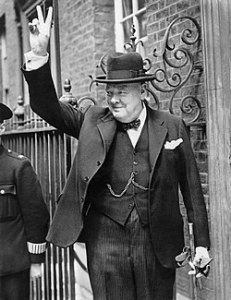
There is a story from history that powerfully illustrates the overarching lesson Jesus was driving home in the parable. On June 4, 1940, Winston Churchill delivered one of his most famous speeches in Parliament. He had been Prime Minister for less than a month, and it was a dark time for his nation. European nations were falling like dominoes to the Nazis, as country after country was either overrun or simply capitulated to Hitler. Everyone around Churchill was telling him to sue for peace. It was the only way, they claimed, that Britain would survive. One research organization reported that civilian morale was low and claimed everyone looked suicidal. The report indicated that only half the population expected Britain to fight, which means the other half expected surrender. This is a description of weary citizens who had lost faith in their ability to survive as a nation.

Churchill disagreed. He did not lose heart and he inspired his fellow leaders, and through them, a whole country to the same hope. On that June day in 1940, he stood before the House of Commons and spoke these rousing words:

“Even though large tracts of Europe and many old and famous States have fallen or may fall into the grip of the Gestapo and all the odious apparatus of Nazi rule, we shall not flag or fail. We shall go on to the end. We shall fight in France, we shall fight on the seas and oceans, we shall fight with growing confidence and growing strength in the air, we shall defend our island, whatever the cost may be. We shall fight on the beaches, we shall fight on the landing grounds, we shall fight in the fields and in the streets, we shall fight in the hills; we shall never surrender, and if, which I do not for a moment believe, this island or a large part of it were subjugated and starving, then our Empire beyond the seas, armed and guarded by the British Fleet, would carry on the struggle, until, in God’s good time, the New World, with all its power and might, steps forth to the rescue and the liberation of the old.”

Churchill’s lethal weapon against the enemy in those dark days was his oratory. Ours is prayer. As long as we can pray, we can fight.  Continual prayer is our declaration, “We will never give up!” until Jesus returns.

Posted in Uncategorized | Tagged , , , , , | Leave a comment

“Nothing in My Hands I Bring”

The tan colored building is where Luther died on Feb. 18, 1546, Eisleben, Germany.

Martin Luther died a public death.  His death was not public in the same way as his hero John Huss’ death was 131 years earlier.  Huss was condemned a heretic by the Council of Constance, handed over to the civil authorities, and publicly burned at the stake just outside the Konstanz Cathedral.  Like Huss, Luther was a priest whose life was transformed when he discovered the Bible.  Like Huss, Luther was declared to be a heretic.  The Edict of Worms (1521) labeled him an “outlaw,” and no doubt, he would have been handed over to authorities for execution, except for the providential hand of God.  Martin Luther lived twenty-five more years during which he preached thousands of sermons, wrote books and pamphlets, continued his teaching at the University of Wittenburg, and translated the Bible into German.  He lived a full life (by 16th-century standards), dying peacefully in the same town where he had been born sixty-two years earlier.

Accounts of Luther’s death were quickly published and disseminated to the public.  Descriptions of his death are preserved in paintings (see here and here), a death mask (see here), and written reports, all of which testified that he died a “good Christian” death.  Dying such a death was important in his day.  How Luther died would either validate or contradict what he had taught.

Catholic propaganda sought to establish its own death narrative for Luther.  Because he rejected several teachings and practices of the Roman Catholic Church (such as papal infallibility, selling of indulgences, that justification was by faith and works), he was put on trial and told to recant his teachings.  Luther would not recant, and was excommunicated by the Church, cutting him off from all the means of saving grace (according to Catholic doctrine), for he could not receive any of the sacraments.  Catholicism teaches that excommunication is a “medicinal” action and not “vindictive,” a corrective measure to bring the exile back to the path of righteousness.  According to the Catholic Encyclopedia, “the exile can have an end (and the Church desires it), as soon as the offender has given suitable satisfaction.”

Because Luther was declared a heretic, his opponents made many attempts to portray his death as horrible, as opposite of a “good Christian” death as they could.  Eleven months before Luther died, a printed letter in Italian reported his death.  A copy of the letter came into Luther’s possession, which he translated into German and published with his remarks.  According to this supposed eyewitness account, the day after Luther’s corpse was buried, his grave was opened and no body was found, but rather a sulfuric stench arose that made people sick.  As a result, it was claimed, many who had followed him returned to the “holy Christian Church” (i.e., the Roman Catholic Church).  Luther was rather bemused and wrote, “I felt quite tickled on my knee-cap and under my left heel at this evidence how cordially the devil and his minions, the Pope and the papists hate me.  May God turn them from the devil!” (Theo. Hoyer, “How Dr. Martin Luther Died,” Concordia TheologicalMonthly, Vol. XVII, No. 2 (February 1946): 81-88).  Other accounts of Luther’s death reported hearing shrieks, seeing devils flying in the air, and a flock of ravens accompanying the corpse on its journey from Eisleben where he died to Wittenberg where he was buried.  Years later it was reported that Luther committed suicide.  These false narratives never took hold because so many witnesses were there.

In this display case is the shroud that covered the casket of Martin Luther. (Martin Luthers Sterbahaus, Eisleben, Germany)

Some people expected that as Luther lay on his deathbed, he would recant his heresies and end his exile from the Catholic Church.  Surely he would want to make peace with God and the Church before death brought the eternal damnation of his soul.  Within a few hours of Luther’s death, five of the sixteen people who were present at his bedside wrote letters describing the scene.  Luther died without any of the trappings of Medieval Catholocism.  He did not request a priest to administer last rites.  He did not dress himself as a monk as some did in hopes of gaining favor with God.  When asked if he died faithful to the doctrine of Christ which he taught, Luther said, “Yes.”  As death drew nearer, he prayed and recited Scriptures.  It was reported that three times he quoted John 3:16.  So peaceful was his death that those with him thought he swooned and relied on the attending doctor to establish that he had died.  It was reported that when Luther died he was holding no consecrated objects like a rosary.  His hands were empty.

Martin Luther, a Roman Catholic priest, monk, and friar was converted by the gospel truth that “the just shall live by faith.”  There was nothing he could do, nothing he could offer to remedy his guilty conscience and take away his sin.  It was Christ alone, by grace alone, through faith alone.  The powerful message of Luther’s empty hands is expressed in a hymn written by Augustus Toplady, an Anglican cleric and theological descendant of the Reformation (he was an ardent Calvinist).  Luther loved music and was a hymnwriter who taught his church to sing.  Though written 231 years after his death, I can hear Martin Luther singing these words with his last fleeting breath:

Rock of Ages, cleft for me,
Let me hide myself in Thee;
Let the water and the blood,
From Thy wounded side which flowed,
Be of sin the double cure,
Save from wrath and make me pure.

Not the labor of my hands
Can fulfill Thy law’s demands;
Could my zeal no respite know,
Could my tears forever flow,
All for sin could not atone;
Thou must save, and Thou alone.

Nothing in my hand I bring,
Simply to Thy cross I cling;
Naked, come to Thee for dress;
Helpless, look to Thee for grace;
Foul, I to the fountain fly;
Wash me, Savior, or I die.

While I draw this fleeting breath,
When my eyes shall close in death,
When I rise to worlds unknown,
And behold Thee on Thy throne,
Rock of Ages, cleft for me,

Let me hide myself in Thee.

Posted in Uncategorized | Tagged , , , , , | Leave a comment